Port Moody Council and Developer Watch Update #3
To what extent are local elections local? In Port Moody, the answer is not so much. While many residents see candidates campaigning, door knocking, and debating, what many residents don’t see is the various outside interests trying to influence the opinions of voters. As Port Moody continues to grow, development approvals are multi-million dollar decisions with significance consequences for Port Moody going forward. The stakes are high. The purpose of the various social media and online campaigns that took place prior to and during the Port Moody election were threefold: (1) to attack perceived political enemies on the council, (2) to promote development, and (3) to data harvest potential supporters’ contact information for further engagement targeting, all in an attempt to influence voters.
Anonymous and Not So Anonymous Facebook and Google Ads in the Pre-Campaign Period
A number of anonymous and not so anonymous social media and online ad campaigns targeting the majority of the old council took place during the Pre-Campaign Period (which ran from Monday, July 18 until September 16, 2022) leading up to the 2022 Port Moody Civic Election. Remember that there is unlimited spending in the Pre-Campaign period and that you only have to register as a third party advertiser during the Campaign Period.
The Pacific Prosperity Network (PPN) Ad Campaign in Port Moody During the Civic Election
In September, 2022 just before the Pre-Campaign Period ended, Chip Wilson’s Pacific Prosperity Network (PPN) thought that the Port Moody Civic Election, the Moody Centre TOD, and attacking the majority of the prior council was important enough to initiate a modest Facebook Ad campaign with accompanying petitions linked from the ads. Here’s a backgrounder on exactly who the PPN are and what they do. Curiously, the PPN ad campaign only ran for five days (from Sep. 10, 2022 to Sep. 15, 2022) just prior to the end of the pre-campaign period and cost approximately $1,800 (at top end estimates). While this may not seem like a lot of money, this amount represents approximately 6% of the entire advertising budget of $30,621 spent by the PPN on all Facebook ad campaigns (Civic, Provincial, Federal and otherwise) from June 30, 2022 to Dec. 30, 2022. Interesting to note too that according to Facebook Meta Ads Library, that the Port Moody Election was the only municipal election subject to an ad campaign launched by the PPN. Not Vancouver, Squamish, Surrey, or any of the other more contested and more controversial elections. Why would that be? And where did the messaging come from that was utilized in the ads? Did the PPN come up with it independently or was there a local source of that messaging with the messaging in turn being supplied to the PPN?
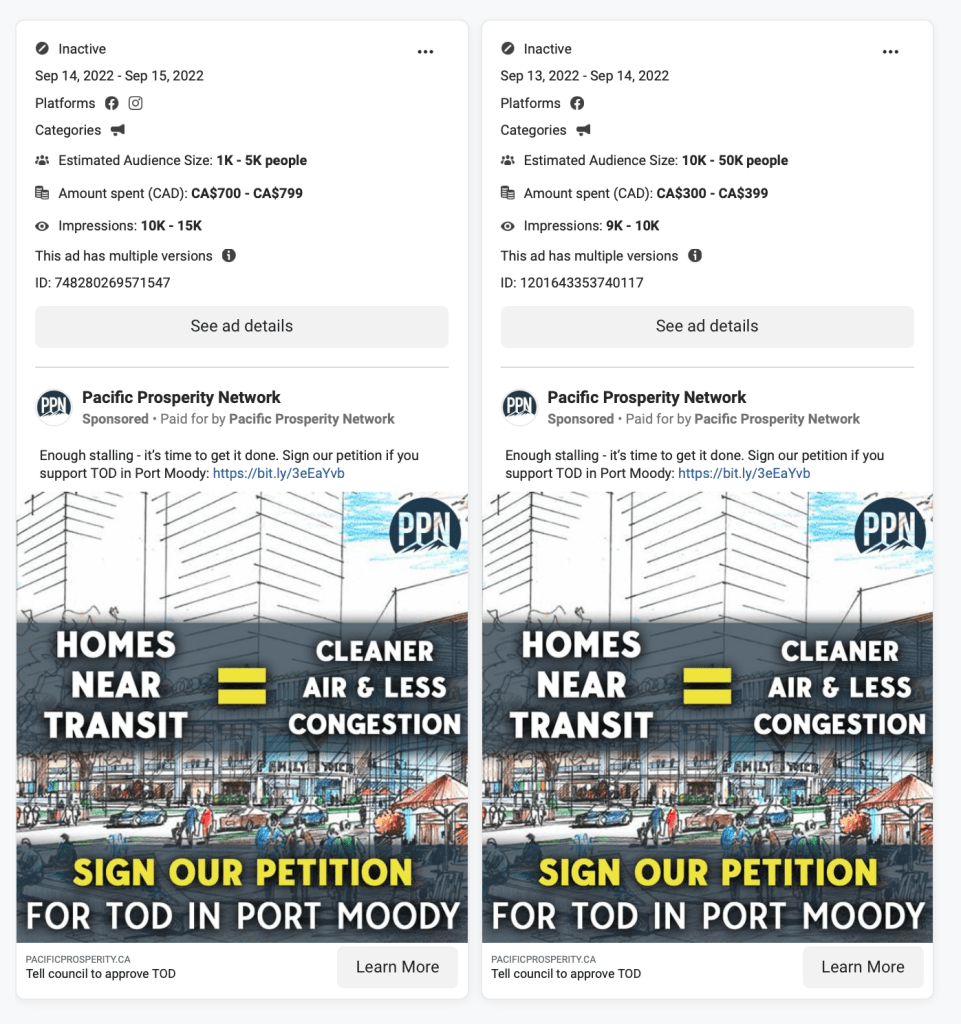
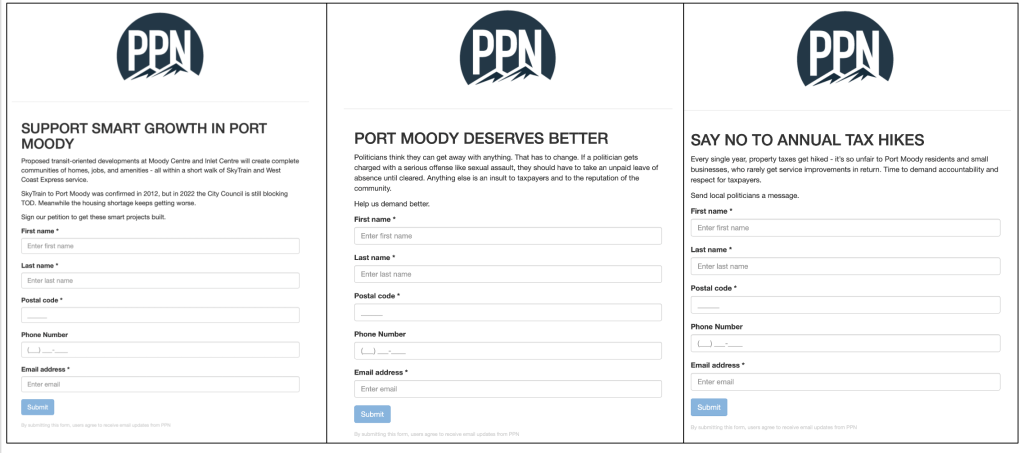
It appears that each PPN ad had its own accompanying petition see here and again here for examples (reproduced below). One wonders where did this data eventually go? Did it make its way to Campaign Support Limited in Ontario?
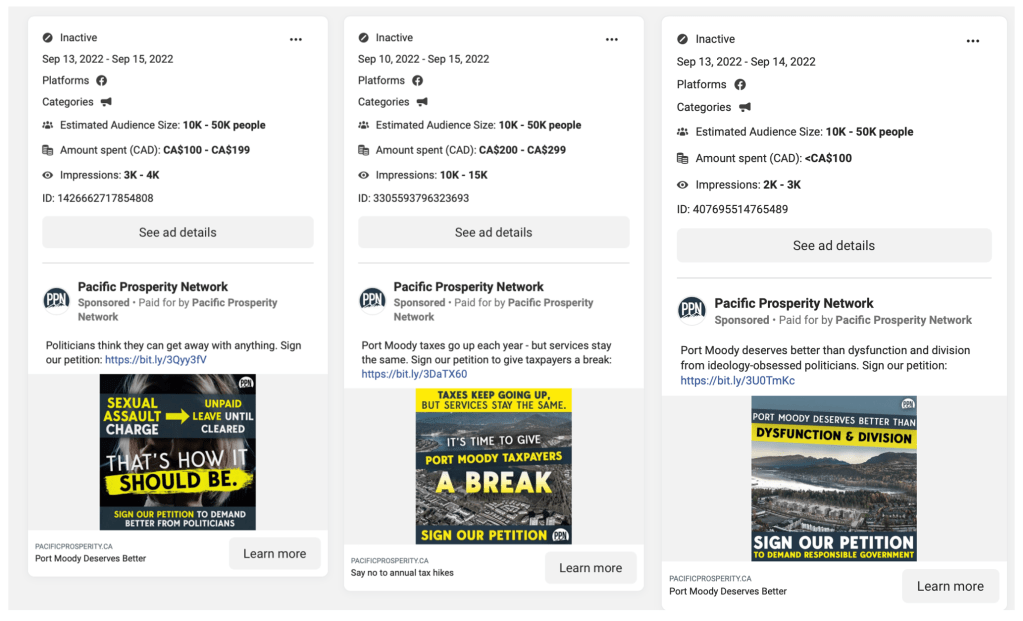
Interestingly, some of the PPN ads (reproduced below) were clearly blatant attack ads and closely mimicked some of the messaging of Lahti supporters and certain councillor candidates.
Incidentally, it should be noted that the PPN has recently been spiking the ball in a recent ad campaign saying that they were very successful in electing candidates at the Municipal level presumably referring to Port Moody since they only choose to advertise there. Again, I would suggest that it is imperative to know who is aligning themselves behind the majority of the newly elected council and ask yourself if that is what largely progressive Port Moody wants and deserves? Perhaps it might be surprising to some that one new councillor used to work for the Fraser Institute and another councillor is a former Federal Conservative candidate under Stephen Harper. Or maybe it isn’t, all things considered.
Together Port Moody Campaign (Google and Facebook Ad Campaign)
In early August, 2022 a social media campaign called Together Port Moody was launched (the webpage as of Jan. 7, 2023 the webpage is not accessible). According to Whois.com, the website was originally registered anonymously on July 20, 2022 and subsequently updated on September 18, 2022. The campaign consisted of a broad social and digital media campaign that included Facebook posts and ads, Google ads, and a website that had a “Keep Up With Us” landing page (reproduced below)
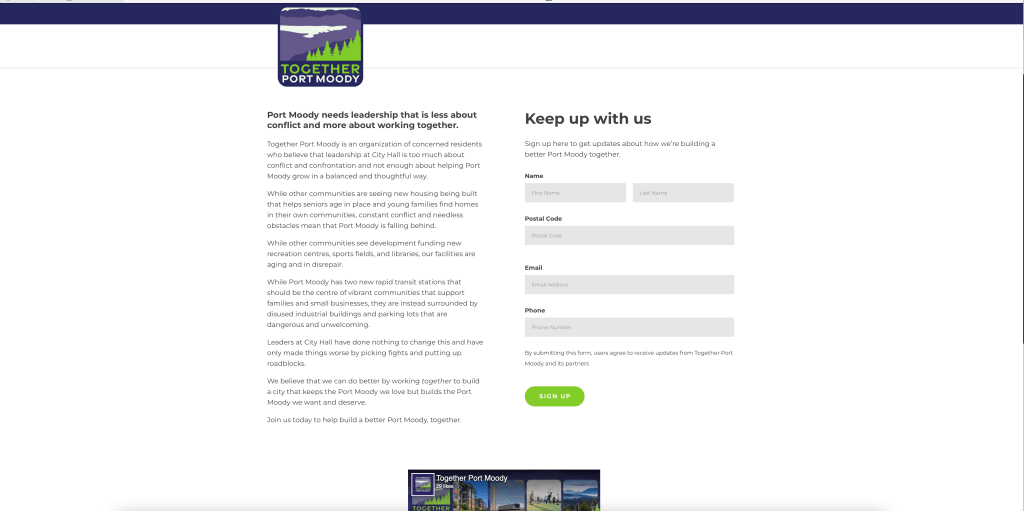
that allowed visitors to voluntarily provide their contact information (name, postal code, email, phone number, etc.) to get updates “about how we’re building a better Port Moody together”. The campaign allegedly represented “an organization of concerned citizens”, a deliberately vague statement I would argue. The Campaign itself consisted of largely rather mundane motherhood statements, broad catchphrases, and empty platitudes that almost everyone could get behind, such as “Let’s work together to improve and expand transportation options” and “Less conflict and more housing options”, etc. These calls to action were inter-mixed with some not so thinly veiled criticisms of the council and how it functioned, i.e., “Port Moody needs leadership” and that Port Moody… “needs leaders who can work together…not put up roadblocks.”, etc.
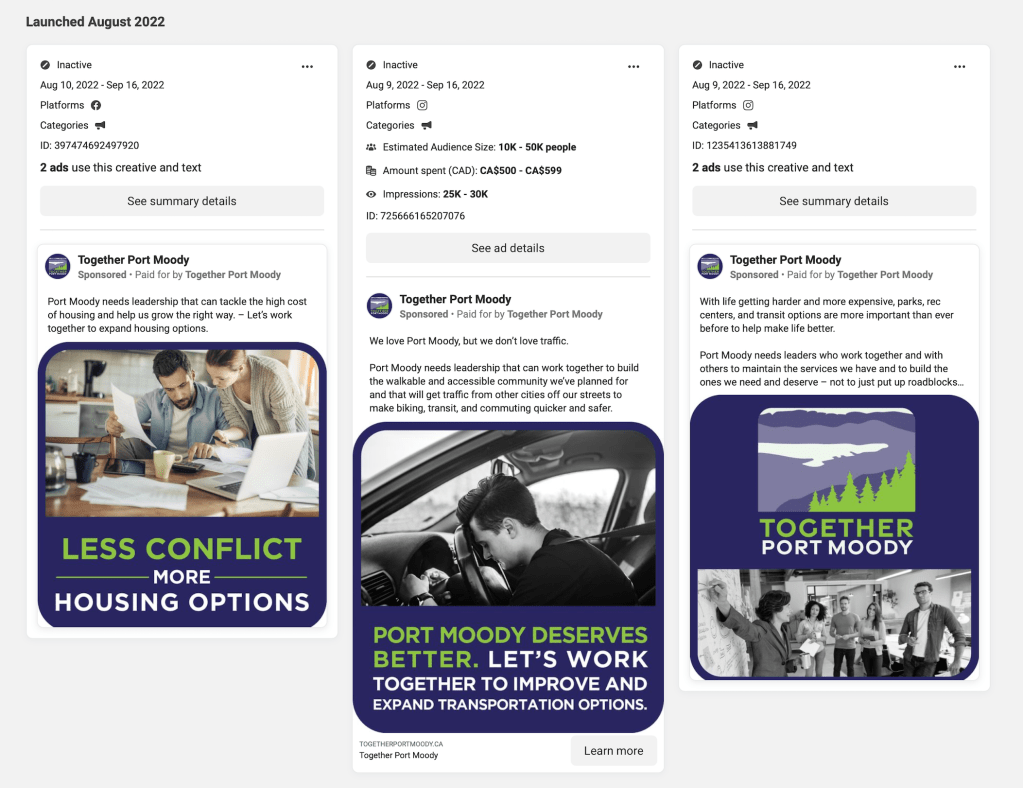
From the outset, it appeared to many observers that the Together Port Moody Campaign was not local in origin and not just a collection of like-minded local “concerned citizens” as the campaign seemed to imply. Rather, various elements of the campaign didn’t make sense in a Port Moody context. For example, one of the ads spoke of wanting increased transit options (see below).
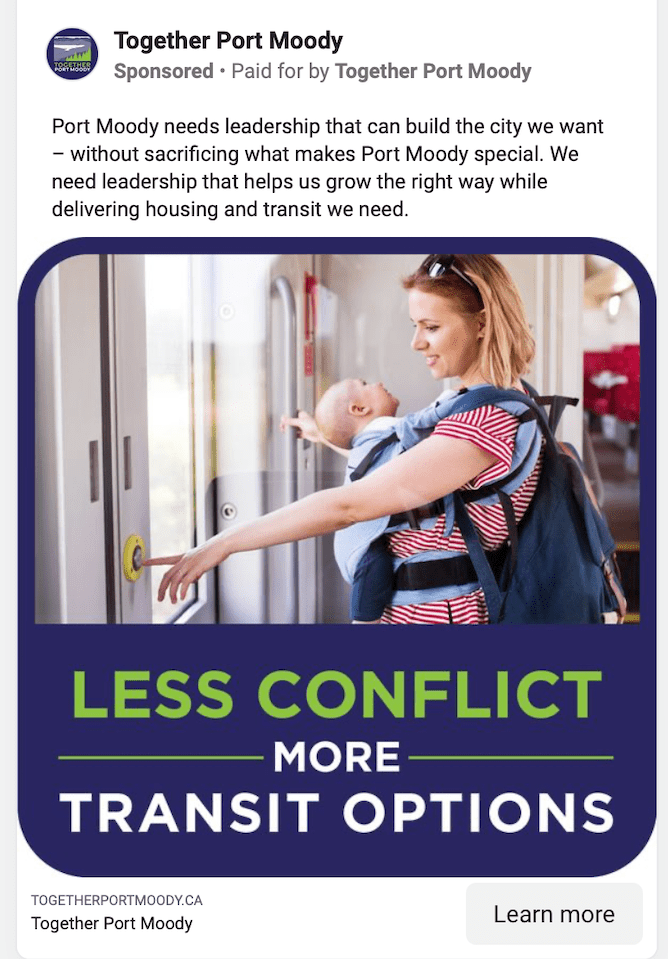
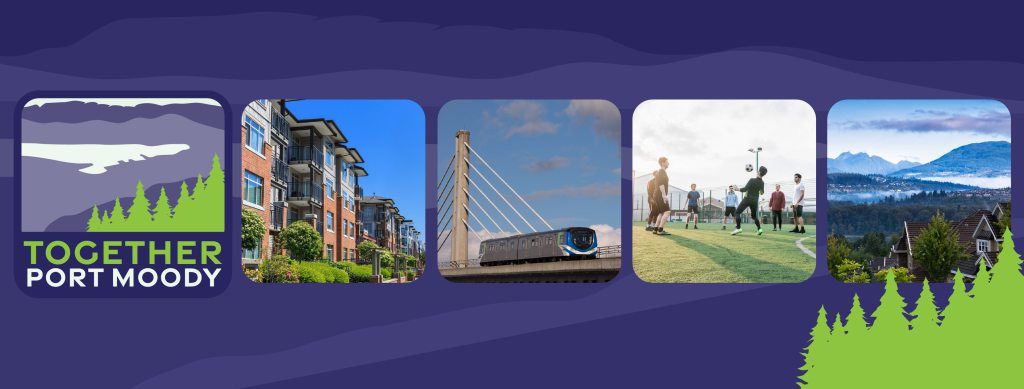
In Port Moody, for those unaware, we already have buses, the SkyTrain, rail lines, the West Coast Express, Uber, taxis, etc., exactly how much more transit do we need? An easy mistake if you were unfamiliar with the area and were designing a campaign for an area that you were unfamiliar with. The lack of any local imagery was also curious given that one would think that a locally designed campaign representing local interests would have multiple pictures of the area. Instead, only stock images were used and none of them depicted Port Moody proper (see below).
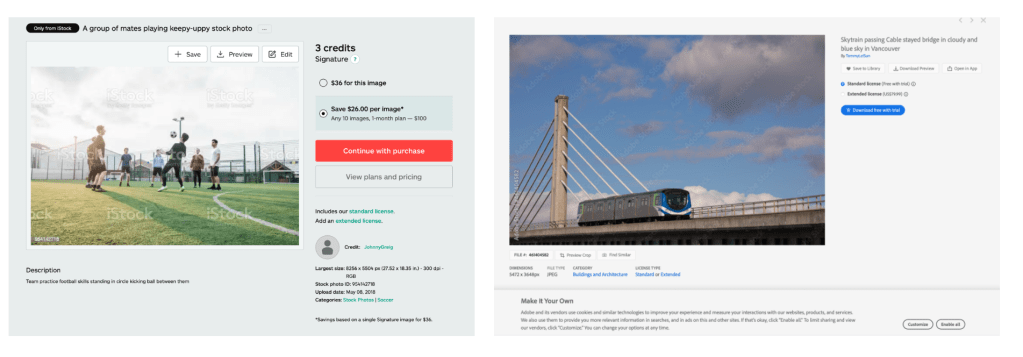
The active Together Port Moody ad campaign ceased (as many predicted) as soon as campaign finance laws required disclosure of who was paying for the ads (the ads stopped immediately prior to the Campaign Period on September 17, 2022). The Facebook ad totals available on in the Meta Ads Library suggest that the Facebook ad campaign totalled approximately $6,000 (top end estimates) while it is unclear what the Google Ad Campaign would have cost as that is not as easy to identify (the Together Port Moody Page was a suggested page during the Pre-Campaign Period in Google, and likely represented a georeferenced and targeted Google ad). The Together Port Moody webpage continued to exist throughout the Campaign Period so while the paid advertising stopped, one could argue that by the website still existing throughout the Campaign period, that the ad campaign never actually stopped.
Many local Port Moody residents were upset with the lack of transparency regarding the Together Port Moody Campaign (see below).

Overall, as noted, the purposes of the various social media and online ad campaigns appears to have been threefold: (1) attack perceived political enemies on the council, (2) promote development, and (3) data harvest potential supporters’ contact information for further engagement targeting. In the case of the PPN ads, individual “petitions” were introduced while for the Together Port Moody Campaign, an online form was present on the landing site. Again, one wonders where the information collected/harvested/scraped as part of the Together Port Moody Campaign, various Facebook ads and posts, and the various PPN “petitions” ended up? And who paid for these ads? Did the data collected make its way to Campaign Support Limited in Ontario to be added to their call voter engagement calls and the get out the vote lists? That remains to be seen. Was this all part of the “super charging” of the voter list suggested as part of Campaign Supports Services provided by Campaign Support Limited?
Pre-Election Survey
For those unaware, details have emerged regarding what seems to have been a rather expensive public opinion survey that took place well prior to the election in early 2022.
I received the below e-mail from a trusted source. This was forwarded to me from someone who had wished to remain anonymous. The person described a survey that they had participated in regarding Port Moody Development and Port Moody Council via a company called LogitGroup based in Ontario (as identified at top of email below) in early 2022 (there’s that Ontario again eh?). I’ve reproduced the email below:
“It was a separate email (February 26, 2022) that identified the survey company as Logit Group: https://logitgroup.com/about-logit-group/
Phone number: 877-404-5897
*******************************
Summary from Port Moody resident:
This was the longest and most complicated survey I have ever participated in. At least 15-20 minutes. She identified who the company was but I can’t remember the name.
The interviewer qualified me up front by asking my age and postal code.
The interview started out with questions about Rob’s performance as a Mayor. There were two questions about his performance; basic ones like was he doing a good job or a bad one.
There were two questions about council’s performance and whether I thought they were doing a good job.
The way I was directed to answer varied with each question. Sometimes I was given a “agree or disagree”, sometimes I had a choice between A or B (which statement I agreed with). Sometimes I had to choose between “most likely agree, and then a sliding scale down to strongly disagree”
Then the survey centered around development in Port Moody.
– Is the council making it too difficult for developers to build?
– Is there too much development in my neighbourhood?
– Do I agree with the statement that building more housing will reduce the prices and make it more affordable?
– Would I support more development in my neighbourhood?
– Should council stand up to the developers?
– Should the council reduce the restrictions on developers?
– Do I agree or disagree with the BC government taking away municipal powers to build more housing? (I disagreed)
– Are we in a housing crisis?
Quite a few questions asking whether more development will reduce the housing prices. I always answered that more housing does not appear to reduce local housing prices and, in fact, the prices continue to escalate.
– Questions about the mix of development, ie should there be more single family homes, more family oriented development, more apartments?
– I was asked what the priorities for developments should be and given choices between; environmental sustainability, affordability, day care spaces, amenities, walkability, close to grocery stores, building around Skytrain stations.
– I was read a series of statements attributed to either unidentified “council members” or perhaps to “potential candidates in the coming election” — I can’t quite recall how they framed it — and then was given a choice as to whether those statements would make me more, or less, likely to vote for them.
– There seemed to be 4 or 5 statements, with some leaning toward standing up to developers and two leaning toward loosening restrictions on developers. I can’t remember all the questions but the following three stood out.
There was one about standing up to developers and making sure affordability is a priority and that, otherwise, we will just end up in traffic grid lock.
That developers are interested in profits and the council should make sure that affordability is included in proposals.
That adding more apartments will not solve the housing crisis, but will only bring more people here and the emphasis should be on “locals first” and “rent controls”
– What is the number one concern about development? Traffic was included and I identified that as my number one concern.
I was allowed to make comments and she recorded those.
I was allowed to break apart some of the questions that linked the insinuation that more housing equals lower prices. For example, I was asked the question “would you support more housing in your neighbourhood that will help reduce housing prices?” I was allowed to say that I would support more housing but that I disagreed with the assumption that more housing leads to reduced prices and, in fact, I am seeing the opposite.
She carefully wrote that down and asked me to repeat it. She did this with each comment I made to the various questions.”
My understanding from the source was that there was a phone survey first (10-20 minutes) and then, depending on your answers, you were invited to participate in a focus group. Attendees at the focus group were paid $135 total for two hour sessions which were conducted via Zoom. My source said that the individual who took the survey had a choice of day/times. The source’s recollection was that there were three time slots available over three days (so nine sessions in total at a minimum). The source thought there were nine people in their group and in each of the other groups. Assuming full attendance in each of the Zoom sessions, that would suggest for the focus group would have cost $10,935 in honorariums alone (at a minimum) suggesting that some rather big money was being spent on this survey and its associated focus groups. My source suggested given the nature of the study, that it was almost 100% likely that this was developer-funded and that this may have been the basis of much of the messaging used by the Lahti campaign during the election. This is likely where the co-opting of the “moderate growth” mantra began as this was likely a key message from the survey as it was in the recent survey conducted by the City of Port Moody as part of the OCP Engagement Process “Port Moody 2050 Community Survey #3 Summary – Land Use Scenarios” where 57% of respondents opposed high-rises up to 26 storeys for the Moody Centre Area with a clear preference for mixed use and lower rise buildings and 66% disagreed with the OCP currently envisioned Oceanfront District with buildings up to 38 storeys and a mix of land uses, such as retail/commercial, residential, entertainment, light industrial, open space, and institutional/research facility preferring instead to see an emphasis on lower density and park expansion.
True North Hit Piece
Councillor Hunter Madsen, who was obviously a thorn in the side of local developers, portrayed as “anti all development”, described as having an “anti-development ideology”, and who was a strong opponent of the extension of the road ROW through Bert Flinn Park, was the subject of a malicious hit piece for the Far Right Calgary-based media outlet True North two days before the election. I will not give the article the dignity of being linked to here. The article was shared with glee by many Lahti supporters and members of the campaign team including a former councillor. I personally do not think that it was a coincidence that the piece was published when it was. Why would True North a primarily national right wing media outlet be interested in the election of a Port Moody Councillor anyway? I suspect that local and maybe not so local right-leaning individuals with a hate on for Hunter and what he represented likely fed the story idea to True North and that the article appears to have been purposely timed to coincide with the Port Moody Civic Election. I will be following up with the author of the article to see if he would be willing the share the source for the story tip. I sincerely doubt that he independently came up with the story idea himself but who knows?
That’s it for Update #3. Stay tuned for Update #4 which will focus on how ingrained the development community has become in Port Moody Civic politics. The extent may surprise you. Actual moderate growth everyone!
Got any tips that we should know about? Send us an email at tips@portmoodycouncilwatch.ca
 Port Moody Council and Developer Watch
Leave a comment